Papam Prathap OTT Review:
There have been many films built around a hero’s personal flaw or unusual problem and turned into entertaining hits. Films like Bhale Bhale Magadivoy and Mahanubhavudu belong to that category. Ghajini took a more serious route with a similar single-point concept. The success of such films depends entirely on how strongly that central idea is handled and what emotions or entertainment are mixed around it. If the core issue weakens, the whole film slips off track. That’s the risk with these “single-point” stories.
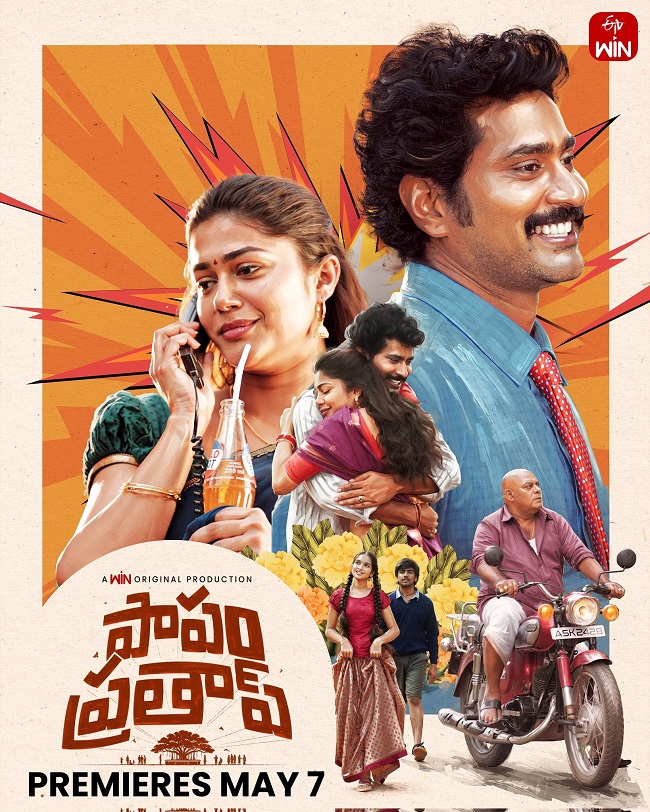
Now comes Papam Prathap, another film that revolves around one central problem. Streaming now on ETV Win
, the film tries to build comedy and emotion around a hidden issue. But does it really work?
Prathap (Thiruveer) deeply loves Bujjamma (Payal Radhakrishna) from childhood and eventually marries her. The first three nights of marriage go smoothly, but on the fourth day, Bujjamma shocks everyone by calling for a village panchayat and declaring that she cannot continue living with Prathap. She leaves for her parents’ house but refuses to explain why.
Even Prathap himself has no idea what went wrong. When he asks her, she simply says, “The problem is yours. Figure it out, solve it, and then come bring me back.”
From that moment onward, Prathap desperately tries to discover what exactly his “problem” is. Whether he succeeds in overcoming it forms the rest of the story.
The teaser and trailer already hinted at this mystery. The makers cleverly avoid revealing the issue because once the audience knows it, much of the suspense disappears.
That is exactly the biggest challenge with films like this. The audience naturally becomes curious about the hidden issue, but once it is finally revealed, there’s always the danger of people reacting with, “Oh… that’s it?” The director must then compensate by handling it either emotionally or humorously.
Films like Bhale Bhale Magadivoy and Mahanubhavudu treated their heroes’ flaws in an entertaining and humorous way, while Ghajini approached it seriously. Unfortunately, Papam Prathap struggles to fully succeed in either direction. Until the secret is revealed, the film stays reasonably engaging, and some comedy portions work in bits and pieces. But there is hardly a scene that makes you laugh out loud.
The director attempts comedy using awkward adult jokes, scenes involving Shakeela, and misunderstandings suggesting there’s something suspicious between two male friends. Most of those efforts feel forced. Ajay Ghosh brings some relief with his performance and manages to generate a few laughs.
The film also reveals the hero’s problem gradually instead of all at once, which helps maintain suspense until the interval, though it also creates some lag.
By the second half, Prathap fully understands his issue and starts trying to overcome it. Some of those attempts are amusing, while others become tiring. The track involving Avasarala Srinivas fails to leave much impact. Later, Prathap publicly tries to prove before the village that he has overcome his issue, and while the idea has comedic potential, the scenes drag too much.
At one point, the entire village tries different methods to put the hero to sleep. Ironically, instead of helping the hero sleep, those scenes may make the audience sleepy instead.
The “solution” to the problem also feels overly simplistic — almost like a magic trick. It leaves you wondering why nobody thought of this much earlier and avoided all the drama.
As an actor, Thiruveer gets good scope to explore different shades in this role. However, he works better in emotional scenes than in comedy. Payal Radhakrishna’s character feels inconsistent, and the role could have been written with more strength. Ajay Ghosh once again proves dependable in a familiar but effective role.
Some comedy involving Goparaju Ramana feels outdated and below the usual standards expected from ETV Win content. A few dialogues written by Prasad Behara stand out here and there.
To its credit, ETV Win
continues attempting reasonably quality content, and the production values suit the story well. The songs are decent but not particularly memorable.
Several scenes in the second half could have been trimmed. Some adult-toned scenes in the first half could have been removed entirely. Director S. P. Durga Naresh spends too much time on side elements instead of focusing strongly on the core issue. And when the film finally reaches the main conflict, it seems unsure how to handle it convincingly.
Overall, Papam Prathap delivers a few scattered laughs and occasional emotional moments. In the end, more than anything else, you simply end up feeling — “Poor Prathap.”